 Whenever we go out on the streets for a “Face the Truth” Tour, we can always count on someone happening by our display to tell us that by showing graphic abortion pictures in the public square, we’re doing more harm than good. This is a charge we’ve heard often enough that we address it as one of the most Common Objections we hear.
In our response to this oft-raised argument, we plainly make the observation that throughout modern history, any number of successful social reform movements — from the movement to enact child labor laws to the civil rights movement — have used disturbing images that depict victims of maltreatment and violence, and that public support for the reforms these movements sought could not have been garnered without publicly showing graphic images of the victims.
Putting a Human Face on the Victims
The intent behind displaying graphic abortion pictures is the same, of course, for it puts a human face on the victims of what is, for far too many people, merely a theoretical concept or political issue.
Lewis Hine believed it was necessary to show victims of cruelty of the child labor industry, and Mamie Till believed it was necessary to have an open-casket funeral for her son Emmett after he was brutally murdered by violent racists.
We display graphic pictures of aborted babies for the same reason: because they work. That is, in the eyes of the viewer, the images elicit sympathy for the victims of injustice.
In the case of reform movements that have employed the use of graphic pictures in working to effect social change, it perhaps goes without saying that one commonality these movements share is that it is members of the movements themselves that are the ones who initially seek to disseminate them.
However, a movement closely associated with one of the martyrs whose feast day the Catholic Church celebrates today provides an exception to this rule.
Graphic Pictures of Blessed Miguel Pro, S.J.
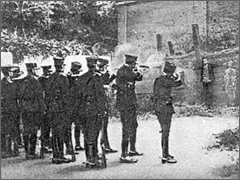
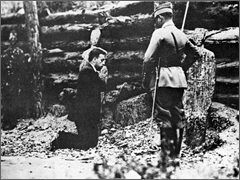 During the 1920s, Mexico was ruled by the virulently anti-Catholic President Plutarco Calles, who began what Graham Greene called “the fiercest persecution of religion anywhere since the reign of Elizabeth.” Among the many Catholic groups who most vigorously opposed Calles were the Cristero rebels.
One of the most well known Cristeros, Blessed Miguel Pro, S.J., was falsely implicated in an assassination attempt on former Mexican President Álvaro Obregón in November 1927, which provided the Calles regime with the pretext for ordering his death.
Father Pro went to his execution on November 23, 1927. Before the firing squad was ordered to shoot, Fr. Pro raised his arms in cruciform and shouted the cry of the Cristeros, “Viva Cristo Rey!” (“Long live Christ the King!”) After the first shots of the firing squad failed to kill him, a soldier shot him point blank in the head.
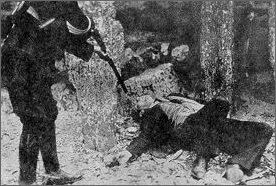 Calles, seeking to cow other Cristeros into submission, had the execution photographed, and newspapers throughout Mexico carried pictures of the executed priest on their front page the next day.
But Calles’ plan backfired. Instead, the images of Fr. Pro’s murder further emboldened the Cristeros to stand up to his oppressive regime.
Graphic Images Work, Regardless of the Intentions of Those Who Display Them
This instance of a public display of graphic images of violence is unique in that the initial act of displaying the images was done by the perpetrators themselves, and not by sympathizers of the victims. Yet the act of displaying them still played a major role in combating injustices committed by the perpetrators, proving that no matter what the motivations are behind the one who is displaying graphic images of violence and injustice, their effect is always the same.
League National Director Joe Scheidler has often remarked that seeing a picture of an aborted baby in the fall of 1972 — just a few months before the Supreme Court’s Roe v. Wade decision — was the impetus for him to commit himself to full-time pro-life work. Along these same lines, I can’t tell you how many times we’ve heard from passersby at our Face the Truth demonstrations comments along the lines of, “I had no idea what abortion was until I saw your signs.”
Because of the overwhelming evidence that graphic pictures do elicit sympathy for the victims of injustice in the eyes of the public, we can surely be confident of their inestimable value in the fight against abortion.
