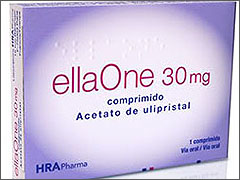
 Although the FDA last week approved the drug “ella” (ulipristal acetate) for prescription use, the controversy over how it works — Is it a contraceptive, or an abortifacient, or both? — shows no signs of going away any time soon.
According to the New York Times, the members of the FDA’s advisory committee that voted to approve it were largely indifferent to this question; all they concluded, in their wisdom, is that it’s supposedly “safe and effective”.
ella’s Manufacturers: It’s Exclusively a Contraceptive
Meanwhile, ella’s manufacturers are going to great lengths to claim that it functions only as a contraceptive and not as an abortifacient. Witness David Archer, whom Slate calls an “expert” for ella’s manufacturer, HRA Pharma of Paris:
Archer says there’s no evidence that ella can interrupt an existing pregnancy or prevent implantation, and other experts point to the drug’s 2 percent failure rate as proof. “At that point, it’s just a microscopic ball of about 256 to 550 or 600 cells that will differentiate in the future,” explains Archer. “You won’t see a head or fingers or any fetal organs.”
Aside from the fact that all human beings — including Archer himself, of course — in the course of normal biological development, once resembled a microscopic ball of a few hundred cells, he is plainly wrong regarding the potential to inhibit implantation, as Dr. Rich Poupard demonstrates.
Poupard goes on to rightly point out:
What should we go by? Experimental evidence that shows that anti-progesterones have a dose-dependent effect on an embryo’s ability to implant, or a guess by a researcher that it might not do that at a low enough dose. Anyone claiming that there no evidence of a post-fertilization mechanism for this drug is not basing their assertion on science. They are merely using wishful thinking.
Regardless of the fact that the FDA’s decision last week approved prescription use of ella specifically as a form of “emergency contraception,” given its ability to operate like the abortion pill RU-486, there is every reason to believe that it can and will be prescribed by doctors for “off-label” use as a post-implantation abortion drug.
The Potential for “Off-Label” Use as an Abortifacient
The Witherspoon Institute’s Michael Fragoso explains:
FDA approval is a notoriously costly and laborious process, and when a drug company submits a “new drug application,” the drug undergoes no fewer than three phases of clinical testing for a specific population (e.g. “adults”), with specific administration criteria (e.g. “by prescription”) for a specific condition (e.g. the treatment of NSAID-induced gastric ulcers). When the FDA approves a drug, it can be marketed by the drug company under the conditions set forth—so the manufacturer can market misoprostol to adults to take the drug by prescription to treat NSAID ulcers. This marketing takes the form of marketing to “learned intermediaries” (physicians) who then recommend and prescribe the drug to patients, or, more recently “direct to consumer” (DTC) marketing, alerting consumers directly what their options are so they inquire with their physicians about the possibility of taking a drug. (The myriad commercials ending with, “Ask your physician if [drug X] is right for you,” following a comically long list of horrible side effects are examples of DTC marketing.) The FDA approval process bears directly on how drug companies can market drugs, not on how physicians can prescribe them.
It is an established fact of law that the FDA does not regulate the practice of medicine. As such, physicians are free to prescribe drugs as the practice of medicine dictates, not as the FDA has approved them. [emphasis added]
Fragoso then asks an important question:
Herein lies an immediate problem: If ella is labeled for use as emergency contraception, but can be prescribed to effect an abortion, what is to prevent Federal monies from subsidizing it as contraception, only to have it used as an abortifacient?
Due in large part to the federal government’s wholly inadequate drug regulatory protocol, the camel’s nose is under the tent.
